
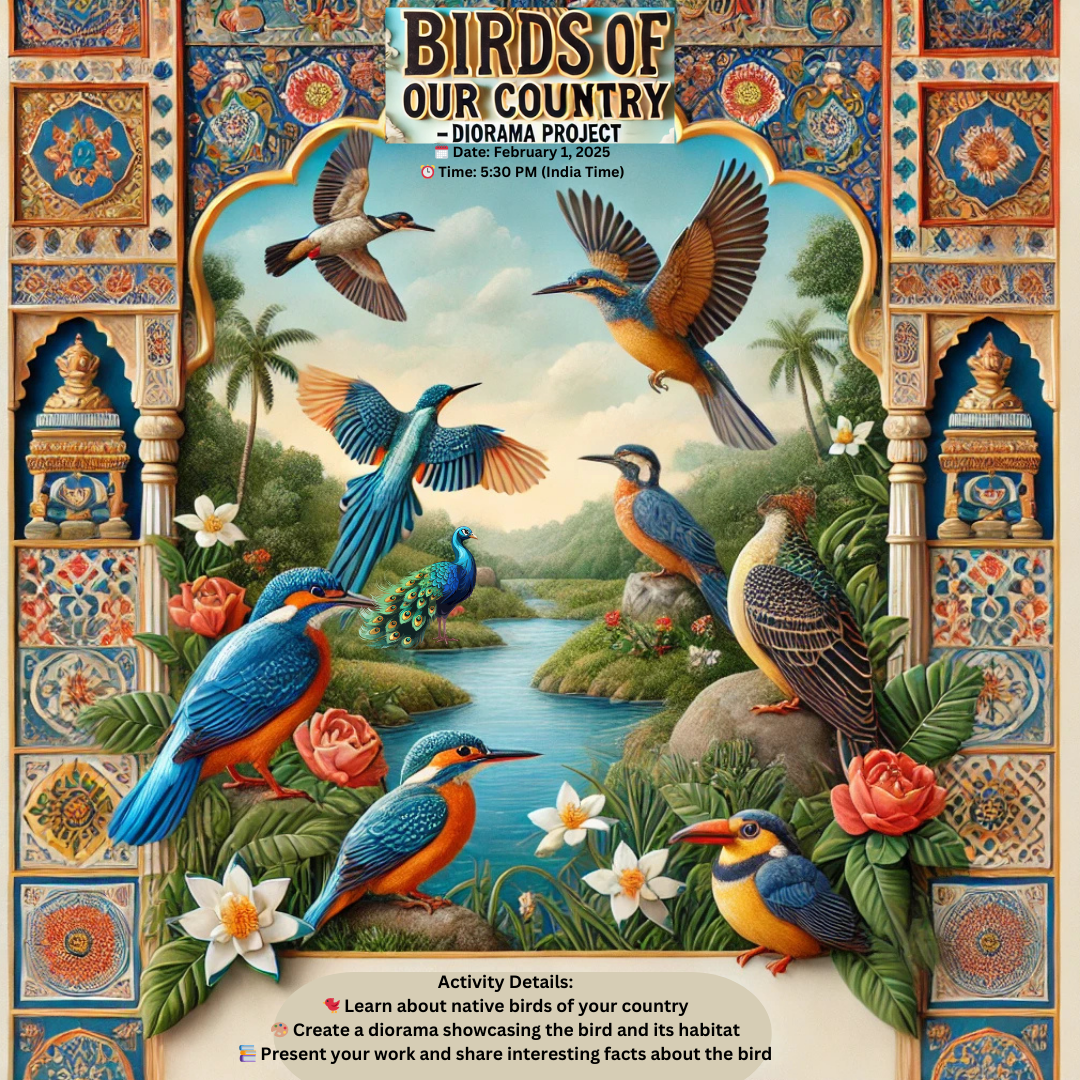
Birds of Our Country – Diorama Project
Lav dette projekt med din klasse
Hvad handler dette projekt om?
- Aldersgruppe
- 9-12,13-15,16-18,18+
- Projektets varighed
- 4 uger
Læringsmål
- Develop understanding of local and global bird diversity.
- Enhance observation and investigation skills.
- Strengthen cross-cultural communication abilities.
- Foster appreciation for wildlife and conservation.
- Build creative and digital presentation skills.
- Understand the role of birds in different ecosystems and cultures.
Kompetencer der udvikles
Projektaktiviteter
Projekttidslinje
Presentation
Step 1: Symphony of our local birds
- Teachers introduce the project by explaining its purpose and guiding students to explore the diversity of birds in their community.
- Students will research interesting facts about local bird species, documenting their behaviors and habitats.
- They will create a digital journal highlighting the most relevant information about the birds.
- Students will select local birds to record their songs and create a "Birdsong Journal" featuring the collected sounds.
Step 2: Virtual art studio with birds
- Students will upload their digital journals, which include information and recordings of bird songs, to the platform's board.
- Encourage students to comment on or ask questions about the shared journals.
- Students will create a diorama representing the habitat of local birds, using visual elements to illustrate the natural environment. This project will allow them to showcase their creativity and attention to detail while highlighting key features of the birds' ecosystem. See the example:
- How to design a diorama
- Motivate students to share photos of their dioramas on the board so others can appreciate and comment on their work.
Step 3: Collaborative celebration
- Organize a videoconference with all participating classes to celebrate and share the outcomes of the project.
- Invite students to present their dioramas and share key findings from their research and "Birdsong Journal."
- Facilitate a discussion where students can ask questions, share observations, and reflect on the similarities and differences in bird species and habitats across regions.
- Conclude with a group reflection on what they learned about biodiversity and the importance of protecting local ecosystems.
Assessment and reflection ✍️
- Evaluate student participation in research and presentation.
- Monitor engagement in cross-cultural discussions.
- Assess quality of digital content creation.
- Observer student interaction during virtual exchanges.
- Group discussions about cultural insights gained.
- Written reflections on personal growth and learning.
Teacher tips 💡
- Foster a safe and inclusive learning environment that values diverse perspectives and experiences.
- Provide clear guidelines and expectations for respectful communication and collaboration. We suggest you review the coexistence policies of Class2Class.org.
- Facilitate the formation of diverse international teams, ensuring a mix of skills, backgrounds, and perspectives.
- Provide scaffolding and support throughout the research and action planning process, offering guidance and resources as needed.
- Encourage student agency and ownership of their learning, allowing them to drive the direction of their projects.
- Celebrate student achievements and facilitate meaningful reflection on their growth and the impact of their actions.
This project invites your students to become part of a global community of young naturalists, artists, and scientists! Through Class2Class.org, they'll connect with international peers to explore and celebrate the amazing world of birds. This creative and interactive approach combines science, art, and cultural exchange to make learning about birds engaging and memorable.
Hvad deltagerne siger
Vathsala Nayer Vailathan
 Malaysia
Jhansi Ravikumar
 Indien
🌿✨ Diorama, Birdwatching, Folktales & National Birds! ✨🌿 Today’s session “Birds in our country” , my project from www.Class2Class.org was filled with incredible stories and discoveries! We explored the "WHICH IS IT?" technique with Teacher Hanumant Sir, helping us observe birds like never before by focusing on their habitat, behavior, size, sound, and special features. His passion for bird conservation reminded us that every bird has a story—we just need to watch and listen.Sir shared many interesting books too.You are always amazing Sir! Abinav Deshmukh shared his real life experience sharing his story of how he helped a cute bird. His photography skills amazed us. Thank you Tr Tushar Sir for interesting information about birds. Students from his school presented real ground work helping birds.🦜👀 A student from Malaysia introduced us to their national bird—the Rhinoceros Hornbill! 🏞️🦏🐦 Known for its striking beak and casque, this magnificent bird plays a crucial role in the rainforest ecosystem. Tr Zinzinthin shared in a message that it has a positive effect.It’s fascinating how birds hold deep cultural significance across countries! Speaking of national birds, we also learned that both Myanmar and India share the same national bird—the Peacock! 🦚💙 A symbol of beauty, grace, and tradition, the peacock is woven into myths, folklore, and even religious beliefs in both countries. Another highlight was a beautiful folktale from Myanmar—the story of a king and queen, where the queen's illness could only be cured by the song of the rare Crow Facent. After much effort, the bird was finally brought to her. Placed in front of a mirror, its song miraculously healed her, reminding us of the healing power of nature and birdsong. ✨🎶 Tr Yupin from Taiwan also shared videos, valuable insights on bird conservation, giving us a global perspective on why we must protect these winged wonders. 🌏💚 From India to Myanmar, Malaysia to Taiwan, birds connect us beyond borders. Let’s continue to observe, learn, and protect them together! Thank you Tr Hanumant Sir Tr Tushar Sir Tr Vathsala Nayer Vailathan Tr Zinzinthin Tr Yunping Lu Thank you www.Class2Class.org Jhansi Ravikumar Ambassador www.class2class.org 🦜💬 What’s your country’s national bird? Share in the comments!
HANUMANT DESHMUKH
IndienThe world is too small. We come to know that Rhino Hornbill is the National Bird of Malaysia and The Peacock is National Bird of Myanmaar. The Nature and the winged messanger connect is happening and proceeding for SDGs achievement is happening. Glad to be part of this connection.