Gå til indhold
Gå tilbage
J

JOHN MAINA har oprettet projektet "Math Barriers Around the World:Beyond the Grade: Understanding Students' Mathematical Identity, Learning Barriers, Confidence and Instructional Needs.A Global Research, Inclusion and Intervention ." i Class2Class.org

Anmod om deltagelse
Aktiv
Offentlig
Samarbejd med en anden klasse

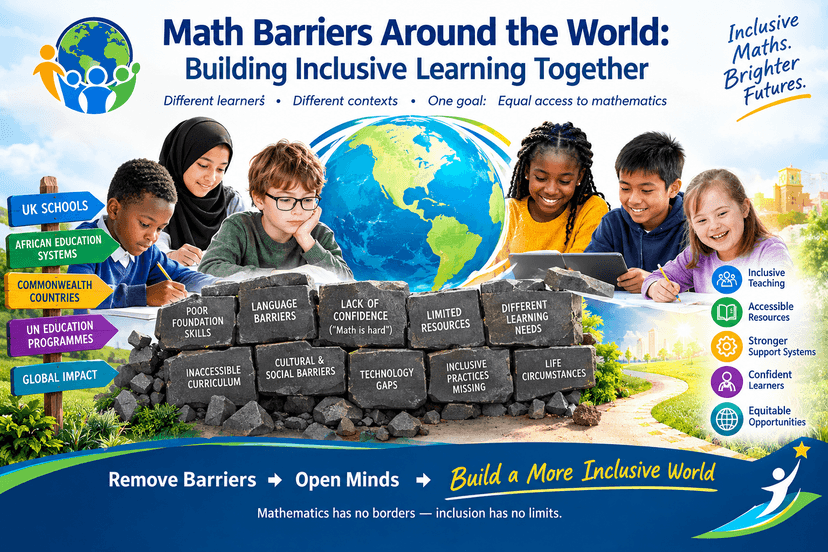
Math Barriers Around the World:Beyond the Grade: Understanding Students' Mathematical Identity, Learning Barriers, Confidence and Instructional Needs.A Global Research, Inclusion and Intervention .

Hvad handler dette projekt om?

Mathematics for Every Learner (MfEL): Global Research and Intervention Project. Mathematics for Every Learner is a global research and intervention project involving teachers and students from different parts of the world. Students complete a shared ...
Elevernes alder
9-12 år, 13-15 år, 16-18 år, 18+ år
Projektets varighed
8 uger
Startmåned
Januar 2027

Dette projekt bidrager til følgende globale mål

Dette projekt fremmer og beskytter disse børns rettigheder

Læringsmål

By the end of the project, the following outcomes are expected. 1. Learner outcomes Learners will be able to: 1. Express their experiences: Communicate their experiences, attitudes and feelings towards learning Mathematics. 2. Identify learning barriers: Recognise and explain the challenges that affect their Mathematics learning. 3. Develop self-awareness: Reflect on their confidence, strengths, difficulties and learning needs. 4. Build global connections: Exchange ideas and experiences with learners from different countries and educational backgrounds. 5. Develop learner agency: Participate in discussions and contribute ideas towards improving Mathematics learning. 6. Develop confidence: Recognise that Mathematics can be accessible to everyone when appropriate support and interventions are provided. 2. Teacher outcomes Teachers will be able to: 1. Analyse learners' responses to identify common and individual learning barriers. 2. Understand how attitudes, confidence, teaching approaches and learning environments influence Mathematics achievement. 3. Collaborate with international colleagues to exchange inclusive teaching practices. 4. Develop evidence-informed interventions using the Assess–Plan–Do–Review (APDR) approach. 5. Adapt teaching strategies to accommodate diverse learning needs. 6. Evaluate intervention effectiveness and use findings to improve teaching and learning. 3. Institutional and global research outcomes Participating schools and the international research team will: 1. Establish a global picture of learners' experiences and challenges in Mathematics. 2. Identify common and context-specific barriers to Mathematics education. 3. Develop and implement evidence-informed school-based interventions. 4. Generate research findings that inform inclusive Mathematics education. 5. Produce a global research report and documentary highlighting learners' voices, teacher experiences and intervention outcomes. 6. Establish an international network committed to Mathematics education for every learner. 4. Measurable indicators of success Area Evidence of achievement Learner participation Completed Google Forms and participation in the joint meeting Learner voice Documented learner experiences and recommendations Teacher collaboration International teacher meeting records Research Analysis of global responses Intervention School-based APDR intervention plans Impact Evidence of changes in confidence, participation and learning Dissemination Global research report and documentary 5. Overall project outcome To create a global, evidence-informed and inclusive Mathematics education framework in which learners' voices guide teachers' understanding, international collaboration informs interventions, and every learner is given an opportunity to experience success in Mathematics.
Huske / forstå
Overall vision: To ensure that learners' voices inform research, research informs interventions, and interventions create meaningful improvements in Mathematics education for every learner, everywhere.
Skabe

Kompetencer der udvikles

Kritisk tænkning & problemløsning
Samarbejde & teamwork
Global bevidsthed
Emotionel intelligens
Tilpasningsevne & ledelse

Projektaktiviteter

1

Share Your Mathematics Experience in the Shared Google Form

Students complete the shared Google Form about their attitudes, confidence, and difficulties in Mathematics. Their honest answers become part of the global dataset that the project's research will use.

Varighed: 45 minutter
2

International Joint Discussion: Sharing Mathematics Experiences Across Countries

Learners and teachers from partner countries meet online to discuss questionnaire results, share their experiences with Mathematics, and suggest improvements. Teachers take notes on key observations and learner contributions for the International Learner Dialogue Report.

Varighed: 120 minutter
3

International Teachers' Meeting: Analysing Barriers and Sharing Professional Ins

Teachers meet online without learners to analyse the Google Form responses and joint discussion notes, identify common and individual learning barriers, and share their professional experiences. The group agrees on the key findings that will shape the Global Mathematics Learning Barriers Research Report.

Varighed: 120 minutter
4

Plan and Run a Mathematics Intervention Using APDR

Students and teachers work together to choose one mathematics challenge, then plan, try out, and review a small intervention in their school. Teachers track confidence, participation, and progress along the way.

Varighed: 120 minutter
5

Global Report and Documentary: Sharing Our Mathematics Story

Students work with the partner class to gather learner voices and intervention results into a shared outline for the global research report and documentary. Each school contributes short clips, quotes, and recommendations to highlight what worked and what still needs support.
Varighed: 90 minutter