
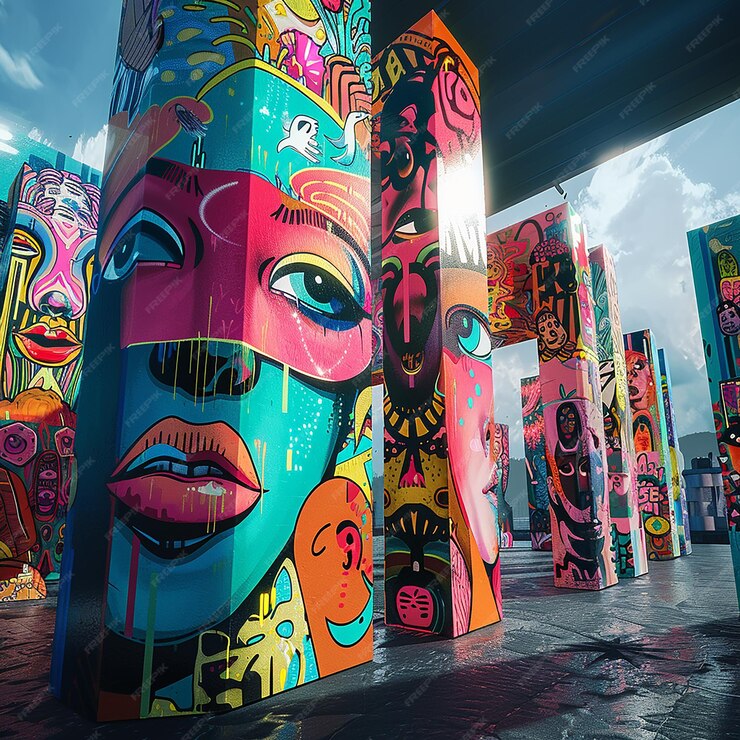
Street Stories: A Global Gallery of Local Expression

What is this project about?

"Street Stories" invites students from around the world to explore and share the vibrant local and street art scenes in their communities. Through this collaborative project, participants will document, analyze, and present the unique artistic expressions that color their local environments. By exchanging their findings with international peers, students will gain a deeper appreciation for cultural diversity, urban aesthetics, and the power of public art in shaping community identity.

Age group
13-15, 16-18, 18+
Project Duration
4 weeks
Language
English, Spanish, Danish

Learning Outcomes

  • Develop an understanding of local and street art as forms of cultural expression and community engagement.
  • Enhance observation and documentation skills through field research in their local areas.
  • Improve digital literacy by using various tools to capture, edit, and present visual information.
  • Strengthen intercultural communication skills through collaboration with international peers.
  • Foster appreciation for diverse artistic styles and their role in community development.

Evaluate

Skills to develop

Intercultural Communication
Global Awareness
Digital Literacy
Critical Thinking & Problem-Solving
Collaboration

Project Timeline

1
Week 1

Presentation

Phase:Presentation & Dissemination

Step 1: Discover and document 

  • Present the project to the students and explain the details of the collaboration they will be carrying out with their international peers.
  • Introduce the concept of local and street art to students, discussing its significance in urban spaces and community expression.
  • Organize a guided walk or virtual tour of the local area to identify examples of street art or local artistic expressions.
  • Task students with photographing or sketching 3-5 examples of local/street art in their community.
  • Ask the students to create a "Global Street Art Map" using Padlet. In this tool, students can upload photos of the artwork they captured, pin their location, and add a brief description.
  • Share the Padlet link in the "Board" section of the Class2Class.org platform so that everyone can access it.

Step 2: Analyze and interpret 
  • Ask the students to select a few pieces of artwork. 
  • Guide the students in analyzing the selected artworks, considering aspects such as style, message, cultural significance, and impact on the local environment.
  •  Encourage the students to research the artists or the context of the artworks, if possible. 
  • Ask the students to prepare brief presentations on the selected artworks. 
  • Students present their findings to their international partners and participate in a Q&A session through the board section of the Class2Class.org platform.

Step 3: Compare and reflect 
  • In class, facilitate a discussion on the similarities and differences observed in street art from various parts of the world. 
  • Guide the students to reflect on how local art reflects cultural identity and addresses community issues.

Step 4: Create and connect 
  • Inspired by the global art they have explored, students create their own artworks representing an aspect of their local culture or a community issue that concerns them.
  • The students share their artworks with their international peers during a video call.
  • Organize a video call with the partner class so that students have the opportunity to discuss their learnings. Here are some suggested questions to start the discussion during the video call:
    • “How does street art reflect your local culture?” or
    • “What have you learned during the development of the project?” 
The students engage in intercultural dialogue by commenting on each other's messages.

Assessment and reflection ✍️


  • Participation and engagement. Create a simple checklist to track student participation throughout the project:
    • Active in local art documentation (5 points)
    • Contributes to the Global Street Art Map on Padlet (5 points)
    • Engages in artwork analysis and presentation (10 points)
    • Participates in class discussions and video calls (10 points)
  • Artwork analysis presentation. Assess students' presentations using the following criteria:
    • Depth of analysis (considering style, message, cultural significance) (10 points)
    • Quality of visual presentation (5 points)
    • Clarity of explanation (5 points)
    • Evidence of research on artist or context (10 points)
  • Reflection and intercultural understanding. Ask students to write a short reflection addressing:
    • What they learned about street art in different cultures (5 points)
    • How their perception of local art changed through the project (5 points)
    • One thing they found surprising or interesting about art in their partner class's community (5 points)

Teacher tips 💡


  • Foster a supportive and inclusive learning environment that values diverse perspectives and experiences.
  • Provide clear guidelines and expectations for respectful communication and collaboration. We suggest you review the coexistence policies of Class2Class.org.
  • Use simple language and visual aids when explaining project steps to younger students.
  • Be prepared to assist with technology use, especially for the younger age group.
  • Celebrate small discoveries to keep students motivated throughout the project.