
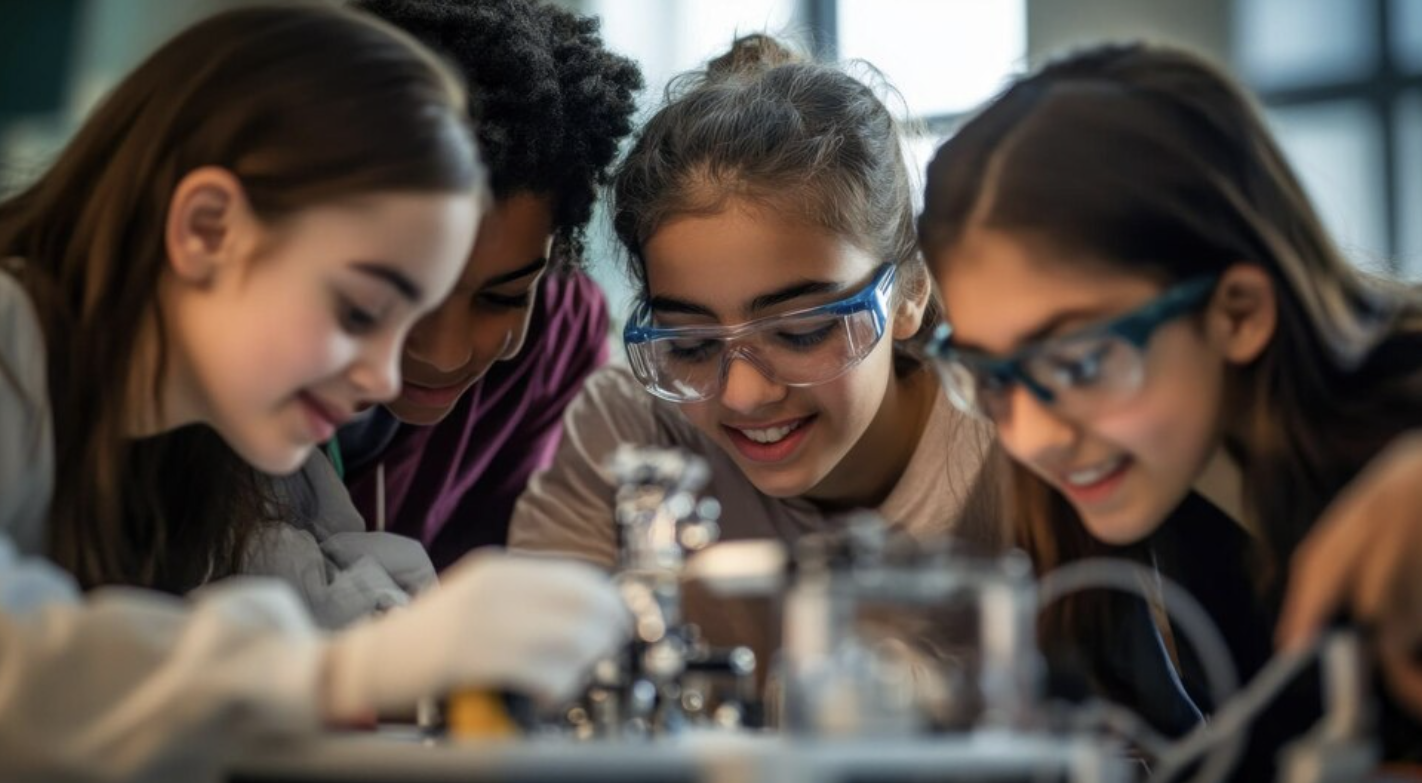
Breaking Barriers: Empowering Women and Girls in STEM

What is this project about?

In this collaborative project, students will use Design Thinking to identify and address barriers that discourage women and girls from pursuing careers in science and technology. Working with international partners, they'll research challenges in their respective communities, develop innovative solutions, and create awareness campaigns to promote gender equality in STEM fields.

Age group
13-15, 16-18, 18+
Project Duration
4 weeks
Language
English, Spanish, Danish

This project contributes to the following global goals
Gender Equality

Learning Outcomes

  • Apply Design Thinking methodology to address real-world gender equality challenges in STEM.
  • Develop research and analytical skills through investigation of local and global STEM education patterns.
  • Enhance cross-cultural understanding of gender barriers in different societies.
  • Create practical solutions to promote women's participation in science and technology.
  • Strengthen digital literacy through collaborative online work.
  • Build presentation and advocacy skills.

Evaluate

Skills to develop

Intercultural Communication
Critical Thinking & Problem-Solving
Global Awareness
Digital Literacy
Collaboration & Teamwork
Adaptability & Leadership
Critical Thinking & Problem-Solving
Collaboration
Innovation
Emotional Intelligence

Project Timeline

1
Week 1

Presentation

Phase:Presentation & Dissemination

Step 1: Empathy

  • Explain the project objectives to the students.
  • Organize groups of 4 or 5 students to work collaboratively.
  • Research local statistics on women's participation in STEM fields to gain insights into current trends and gaps.
  • Compile a list of notable women in STEM and conduct interviews with at least two of them to highlight their experiences and achievements.
  • Share findings with international partners through the platform's board section to foster collaboration and exchange of ideas.
  • Analyze and compare challenges faced by women in STEM across different cultural contexts with input from associated classes, identifying commonalities and unique obstacles.

Step 2: Definition
  • Guide students in creating a visual map to organize the gender equality challenges in STEM they have identified.
  • Use collaborative tools like Padlet to group similar challenges and enhance visualization.
  • Share the map's link on the platform's board to allow international peers to access and review the content.
  • Support students in:
    • Identifying challenges within their community.
    • Recognizing common challenges across contexts.
    • Selecting a specific issue to address.
Students will then delve deeper into the chosen challenge and publish their findings on the platform, encouraging collaborative brainstorming with partner classes.

Step 3: Ideate
  • Facilitate a creative session where students propose potential solutions to the identified problem.
  • Guide the teams to evaluate the ideas and choose the most suitable solution based on the problem and available resources.
  • Use the platform’s board to share the selected idea through drawings, descriptions, or diagrams of the ideal solution.
  • Invite the partner class to review the proposals, provide feedback, or ask questions that encourage reflection and improvements.

Step 4: Prototype
  • Support students in developing a prototype for their solution, which could take the form of a drawing, a digital design, or a mock-up.
  • Encourage the use of recyclable materials to construct prototypes, fostering sustainability in the process.
  • Suggested prototype ideas include:
    • Innovative tools or devices.
    • Creative educational models.
    • Sustainable design concepts tailored to address the identified problem.
  • Some examples:
    1. Science Story Podcast Lab A student-led podcast production initiative where girls create and host episodes featuring interviews with local women scientists, experiment demonstrations, and STEM career insights. Students learn audio editing, scripting, and science communication while building a library of inspiring content that can reach broader audiences. The project combines technology skills with storytelling, making STEM more relatable through personal narratives.
    2. STEM Sisters Social Network A secure, moderated social media platform designed specifically for young women in STEM. Students develop a mobile-friendly website where users can share science experiments, homework help, career guidance, and mentorship opportunities. The platform includes features like "Scientist of the Week," virtual study groups, and project collaboration spaces, making STEM learning more social and supportive.
    3. Girls' Tech Workshop Series A peer-led technology workshop program where high school girls teach coding, robotics, and digital skills to middle school students. The solution includes curriculum development, teaching materials, and a mentorship component. Students gain leadership experience while creating a supportive learning environment that addresses common barriers to technology education for young women.

Step 5: Test and Preparation
  • Guide students in refining their prototype, ensuring it clearly reflects the solution to the identified problem.
  • Support students in preparing a simple PowerPoint (PPT) presentation to explain their proposed solution.
  • Structure of the presentation:
    • Introduction: Briefly summarize the problem being addressed.
    • Solution: Explain how the proposal works and how it tackles the problem.
    • Conclusion: Highlight the conclusions and lessons learned during the process.
This will ensure clarity and effectiveness in communicating with their international peers.

Step 6: Final Presentation
  • Organize a video call with the partner classes to share the final work.
  • Each team presents their prototypes or proposed solutions to the identified problem.
  • Encourage a feedback session where the classes can provide constructive comments.
  • At the end, encourage students to share their learnings and reflections on the process, highlighting how they collaborated to find solutions and what new perspectives they gained throughout the project.

Assessment and reflection ✍️


  • Rubrics to assess student participation, collaboration, and the quality of their research and presentations.
  • Reflective journal prompts to encourage students to think critically about their learning, personal growth, and the potential impact of their actions.
  • Peer and self-assessment opportunities to foster accountability and ownership of learning.

Teacher tips 💡


  • Foster a safe and inclusive learning environment that values diverse perspectives and experiences.
  • Provide clear guidelines and expectations for respectful communication and collaboration. We suggest you review the coexistence policies of Class2Class.org.
  • Facilitate the formation of diverse international teams, ensuring a mix of skills, backgrounds, and perspectives.
  • Provide scaffolding and support throughout the research and action planning process, offering guidance and resources as needed.
  • Encourage student agency and ownership of their learning, allowing them to drive the direction of their projects. 
  • Celebrate student achievements and facilitate meaningful reflection on their growth and the impact of their actions.
This project offers students a unique opportunity to address real-world challenges while developing crucial 21st-century skills. By collaborating with international peers, they'll gain a broader perspective on gender equality in STEM fields while creating meaningful solutions that can impact their communities.

Breaking Barriers: Empowering Women and Girls in STEM - Class2Class | Class2Class