
Anoop Singh has created the project "Energy in Motion: Testing Newton's Cradle Across Cultures" in Class2Class.org
Request to join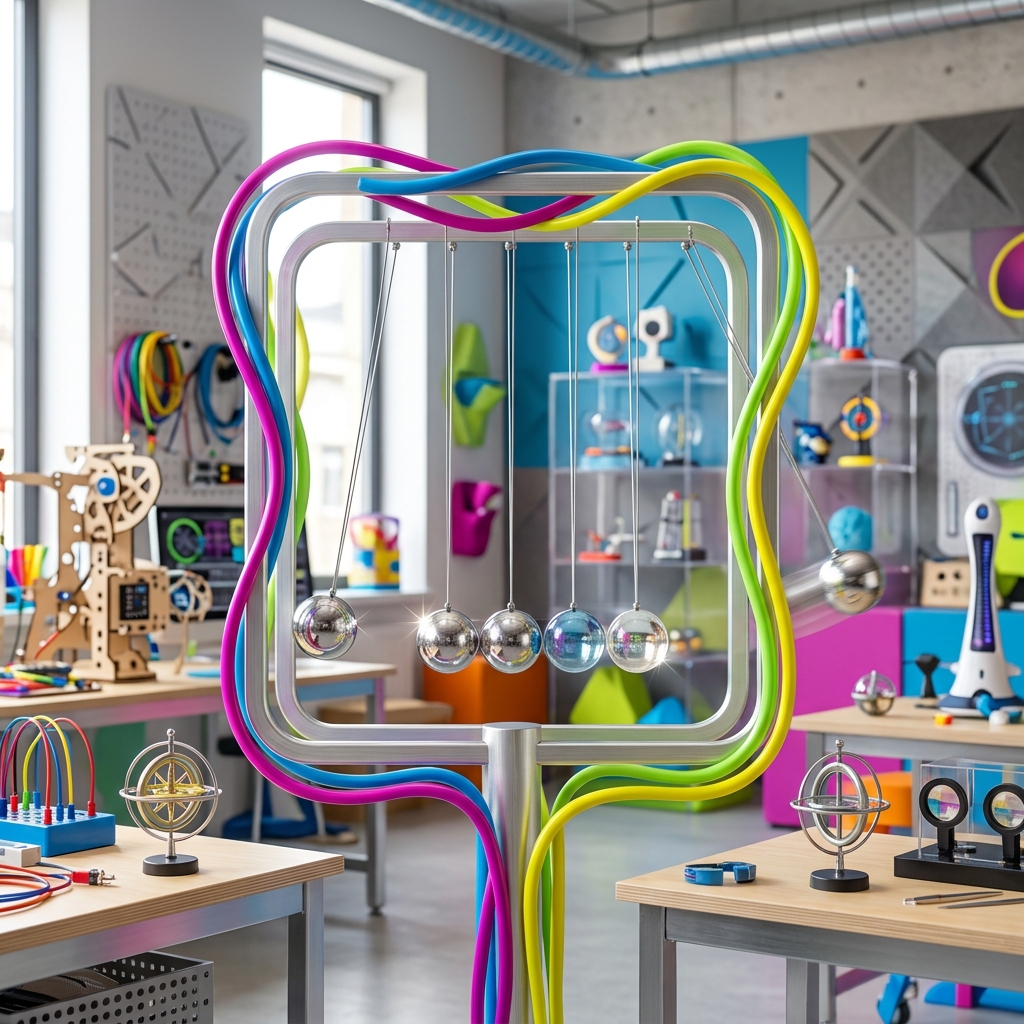
Energy in Motion: Testing Newton's Cradle Across Cultures
What is this project about?
Students test variations of Newton's Cradle using different materials, ball sizes, and string lengths to measure how efficiently energy transfers in each setup, recording data on swing heights and displacement patterns. Working with their internation...
- Age of Students
- 13-15 years
- Project Duration
- 3 weeks
- Starting Month
- August 2026
This project contributes to the following global goals
This project promotes and protects these children's rights
Learning Outcomes
Students will be able to identify and describe how different materials and designs affect energy transfer efficiency in Newton's Cradle systems.
Students will be able to demonstrate critical thinking by conducting controlled experiments with varied ball sizes and string lengths, recording data on swing heights and displacement patterns.
Students will be able to analyze and compare collision efficiency results between their local design variations and international partner class data, examining how friction and air resistance impact energy transfer.
Students will be able to evaluate the effectiveness of different Newton's Cradle designs across cultural contexts and present collaborative findings using digital tools to communicate real-world physics applications globally.
Skills to develop
Project Activities
Newton's Cradle Basics and Partner Class Meet
Students build a simple Newton's Cradle using provided materials and test it with one ball height. Then they meet their international partner class via video call to introduce themselves, share what they observed, and learn about the partner class's local context and physics curriculum.
Design Variations and Data Collection
Students systematically test their Newton's Cradle by changing one variable at a time (ball size, string length, or material) while recording swing heights and displacement patterns. They organize their data in a shared spreadsheet and document their observations on what affects energy transfer efficiency.
Exchange Data and Analyze Efficiency Patterns
Students compare their experimental results with the partner class's data via an asynchronous forum or shared online document. They analyze why some designs lose energy faster, identify patterns across both classes' tests, and discuss how friction, air resistance, and material properties impact real-world energy transfer.
Design Challenge and Prototype Optimization
Based on their analysis, students propose and build an improved Newton's Cradle design aimed at maximizing energy efficiency. They test the new design, compare it to their original, and prepare a brief explanation of the changes they made and why they expect them to work better.
Global Findings Presentation and Reflection
Students create a digital presentation or infographic comparing their local results with the partner class's findings, highlighting how design choices, materials, and real-world factors affect collision efficiency. They reflect on what they learned about physics, international collaboration, and how their discoveries apply to real-world engineering.